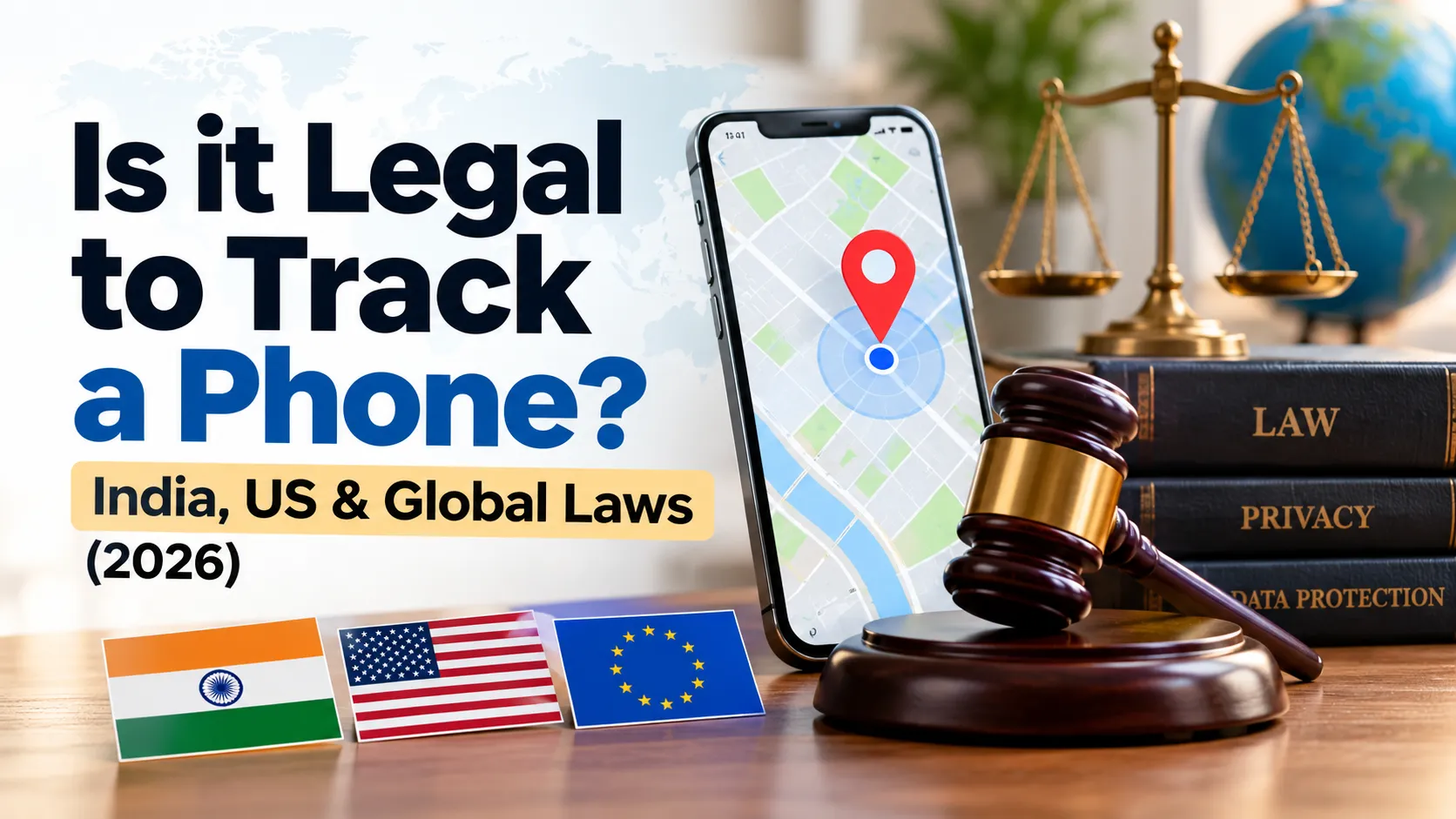
This is the most important question in the entire phone-tracking space, and most sites dodge it or bury it under a paragraph of disclaimers. So here is the answer, upfront.
Tracking your own phone is legal everywhere. Tracking your minor child’s phone is legal in most countries, with conditions. Tracking a company device with employee disclosure is legal, with rules. Tracking another adult’s phone without their informed consent is illegal in virtually every jurisdiction that has a privacy or surveillance law.
That’s the shape of it. The rest of this guide fills in the detail: which laws apply, how the rules differ for parents, employers, and individuals, what “consent” actually means in practice, how India’s new data-protection law changes things, and what can happen to you if you get it wrong. I’m not a lawyer, and this is not legal advice. But I’ve read the actual statutes and spoken to people who have, and I’ll point you to them so you can verify everything yourself.
Why this matters more than you think
Phone tracking isn’t a niche legal curiosity. It’s a daily reality for millions of families, employers, and individuals. And the consequences of getting it wrong range from a broken relationship to a criminal record.
In India alone, the Digital Personal Data Protection Act turned location into legally protected personal data in 2023. In the US, wiretap laws carry federal criminal penalties. In the EU, GDPR violations can lead to fines of up to 4 percent of global revenue. These aren’t theoretical risks. People have been arrested, companies have been fined, and tracking-app operators have been shut down by regulators for enabling unlawful surveillance.
So “is it legal?” isn’t a formality. It’s the first question to answer before you install, share, or track anything.
The three lawful scenarios, and where they stand
1. Tracking your own device
Legal everywhere. No law prevents you from locating, locking, or wiping a phone you own. Google Find Hub, Apple Find My, Samsung SmartThings Find, and similar tools are designed for exactly this. If you lost your phone or it was stolen, using these tools is not just legal, it’s recommended.
The only wrinkle: if you lend or give a device to another adult and continue tracking it without telling them, the device-ownership defence becomes weaker. Ownership of the hardware doesn’t automatically mean you have the right to monitor the person using it, especially if they have a reasonable expectation of privacy. A phone given to a partner as a gift, for example, is usually considered their property for privacy purposes, even if you paid for it.
2. Tracking your minor child’s phone
Legal in most jurisdictions, because parents and legal guardians have a recognised duty and right to protect their children. But the details matter, and they vary.
India. There is no specific statute that says “parents may track children’s phones,” but parental authority is broadly recognised in family law, and the DPDP Act includes provisions for lawful guardians processing a child’s data in the child’s interest. The practical consensus is that monitoring a minor child’s device for safety is lawful, but installing hidden surveillance without any transparency (even with a child) pushes into territory that courts and regulators could question, especially as children get older. Open monitoring with the child’s awareness is both legally safer and more effective. I’ve covered the age-by-age picture in is it legal to track a child’s phone.
United States. Federal law does not prohibit parental monitoring of a minor’s device. Most states follow this, though a few have age-based nuances. The Children’s Online Privacy Protection Act (COPPA) restricts what companies can collect from children under 13 online, but it doesn’t restrict parents from monitoring their own child’s device. The practical rule: on a device you provide to your child, parental monitoring is legal, but recording the child’s conversations with other adults (like a teacher or a friend’s parent) can trigger wiretap laws in two-party-consent states, so be aware of what features you turn on.
European Union. GDPR treats children’s data as specially protected and sets the age of digital consent at 16 (or as low as 13, depending on the member state). Parental monitoring of a younger child is recognised under parental authority, but as the child approaches the age of consent, their independent privacy rights grow. The practical guidance from most data-protection authorities is that parental monitoring should be proportionate to the child’s age and communicated openly.
The common thread. No country bans parents from monitoring a minor child’s device outright. But everywhere, the expectation is moving toward transparency: tell the child, match the monitoring to their age, and don’t go further than safety requires.
3. Tracking a company-owned device with employee disclosure
Legal in most jurisdictions, provided the employer meets specific conditions.
India. The DPDP Act requires a lawful basis for processing personal data, and the employer-employee relationship can provide one, but only with proper notice. The employee must be informed in writing, before monitoring starts, what data is collected, why, and who has access. Monitoring a personal device without consent is not covered by this basis.
United States. The Electronic Communications Privacy Act (ECPA) generally allows employers to monitor company devices, especially where the employer has a legitimate business reason and the employee has been notified. State laws add variations. Connecticut and Delaware, for example, require written notice before electronic monitoring. Courts have consistently held that monitoring a personal device without consent, even for an employee, crosses the line.
EU. GDPR and the e-Privacy Directive require a legal basis (usually legitimate interest or contract performance), a clear privacy notice, a Data Protection Impact Assessment for high-risk monitoring, and proportionality. Blanket surveillance (tracking everything, all the time, with no business justification) is unlikely to pass the proportionality test.
The common thread. Company device plus written disclosure plus a reasonable scope equals lawful. Personal device or secret monitoring equals a lawsuit waiting to happen. For the full India-specific picture, see employee phone monitoring laws.
The illegal scenario: tracking another adult without consent
This is where most of the internet’s “how to track a phone” content goes wrong, and it’s where the law is clearest.
Installing a monitoring app on another adult’s phone without their knowledge and consent is illegal in virtually every country. In India, it violates the DPDP Act (processing personal data without lawful basis), the Information Technology Act (unauthorised access to a computer resource, punishable with up to three years in prison), and potentially the Indian Penal Code (stalking, harassment, invasion of privacy). In the US, it violates federal wiretap law (the Wiretap Act, 18 U.S.C. 2511) and the Computer Fraud and Abuse Act, plus state-level stalking and privacy statutes. In the EU, it violates GDPR and national criminal law.
This applies regardless of your relationship. A spouse, a partner, an ex, an adult child, a sibling, a friend. The relationship doesn’t create a right to covert surveillance. “I pay the phone bill” doesn’t create a right either, unless the phone is used by your minor child under your guardianship.
The penalties are real. In India, the IT Act provides for imprisonment of up to three years. In the US, wiretap violations carry federal prison time. The FTC has taken enforcement action against tracking-app companies (SpyFone/Support King, Retina-X) specifically for enabling covert partner surveillance, ordering them to delete data, notify victims, and exit the surveillance business. These aren’t warning letters. They’re bans.
SpyHuman explicitly prohibits this use in its Lawful Use Policy. If you’re considering installing monitoring software on another adult’s phone without their knowledge, the answer from the law, from us, and from common sense is don’t.
India’s DPDP Act: what changed
India’s Digital Personal Data Protection Act, 2023 is the biggest recent shift for anyone in this space. Here’s what matters.
Location is personal data. The Act covers any data that identifies a living person, and location clearly qualifies. Collecting it without consent or another lawful basis violates the Act.
Consent must be free, specific, informed, and clear. A buried checkbox or a vague “we may track you” doesn’t count. The person must actually understand what they’re agreeing to.
Children get extra protection. Data Fiduciaries (companies processing data) must obtain verifiable parental consent before processing a child’s data. The definition of “child” will be set by rules, expected to be under 18.
A Grievance Officer is mandatory. Any company processing personal data in India must appoint one, and data principals (the people whose data it is) have the right to complain.
The Data Protection Board of India is the enforcement body. It can impose penalties for violations, though the penalty structure is still being finalised through rules.
For SpyHuman’s users, this means three things. If you’re monitoring a child’s device, you’re the parent exercising lawful authority, but do it openly and proportionately. If you’re an employer, you need proper disclosure and a limited scope. If you’re considering tracking an adult without consent, the DPDP Act gives that person a complaint route and gives the Board enforcement power. The legal risk just got concrete.
What about location sharing? Is that tracking?
Voluntary location sharing (through Google Maps, WhatsApp, Life360, or similar) is fundamentally different from covert tracking, and the law treats it that way.
When someone shares their location with you, they’ve consented. They can see that they’re sharing. They can stop at any time. This is not surveillance. It’s a convenience they’ve chosen.
The line blurs when sharing is coerced. If someone “agrees” to share their location because they’re afraid of what happens if they don’t, that consent isn’t freely given, and the law in most jurisdictions doesn’t treat coerced consent as valid. Context matters.
For more on the practical and ethical difference between consensual tracking and covert surveillance, read how to track a phone the right way: with consent.
What about using a phone number to find someone?
Looking up a phone number to identify a caller (operator, circle, spam label) is not tracking and raises no legal issues. You’re screening your own calls.
Using a phone number to continuously monitor another person’s location without their consent is tracking, and everything above applies. No consumer tool can do this from a number alone anyway, as I’ve covered in can you really track a phone by its number and how to identify an unknown number.
What can happen if you break the law
I want to be specific, because vague “you could get in trouble” warnings don’t land.
In India: up to three years imprisonment under IT Act Section 43/66, plus penalties under DPDP once the Board is fully operational, plus a potential stalking charge under IPC 354D.
In the US: federal Wiretap Act violations carry up to five years in prison per offence. State charges can stack on top. Civil suits for damages are also available to the victim.
In the EU: GDPR fines up to 20 million euros or 4 percent of global annual revenue, whichever is higher, plus criminal liability under national law.
And beyond the law: divorce proceedings routinely treat covert phone monitoring as evidence of controlling behaviour. Employment tribunals treat covert employee monitoring as grounds for unfair-dismissal claims. Relationships, careers, and reputations end over this.
What about recording calls and messages?
Tracking location and reading messages are different things legally, and the rules are often stricter for communications.
In India, the Indian Telegraph Act restricts interception of communications to authorised government agencies. Recording a call you are a party to (you are one of the callers) is generally not prohibited, but recording a call between two other people without authorisation is illegal. Accessing someone’s messages through a monitoring app falls under the IT Act’s provisions on unauthorised access.
In the US, federal wiretap law allows recording a call if one party consents (you, as a participant). But 11 states (including California, Florida, and Illinois) require all parties to consent. A monitoring app that records calls or reads messages on someone else’s phone without their knowledge violates both federal and state wiretap laws.
In the EU, national implementations vary, but the e-Privacy Directive requires consent for intercepting communications in almost all cases.
The practical rule: if a monitoring app offers call recording, message reading, or similar features, using those features on another adult’s phone without their knowledge is almost certainly illegal, regardless of where you are. On your own phone or a minor child’s device under parental authority, the position is more permissive, but even there, recording the child’s conversations with other adults can trigger wiretap protections for those adults.
GPS tracker devices (not just apps)
This guide has focused on phone-based tracking, but physical GPS tracker devices (small units you attach to a vehicle or slip into a bag) raise the same legal questions.
In India, using a GPS tracker on your own vehicle is fine. Placing one on someone else’s vehicle or belongings without their knowledge is illegal under the same privacy and IT Act provisions.
In the US, the Supreme Court ruled in United States v. Jones (2012) that attaching a GPS device to a suspect’s vehicle constitutes a search under the Fourth Amendment and requires a warrant. For private individuals, placing a tracker on someone else’s vehicle is illegal in most states.
So the principle holds across methods: tracking yourself or your property is fine, tracking another person or their property without consent is not, whether the tool is an app or a physical device.
Penalties at a glance
| Country | Law | What it prohibits | Maximum penalty |
|---|---|---|---|
| India | IT Act Section 66 | Unauthorised access to computer resource | 3 years prison + fine |
| India | IPC 354D | Stalking (includes digital) | 3 years prison (first offence) |
| India | DPDP Act 2023 | Processing personal data without lawful basis | Penalty up to INR 250 crore (rules pending) |
| US | Wiretap Act (18 USC 2511) | Intercepting communications | 5 years federal prison per offence |
| US | CFAA | Unauthorised access to a computer | Up to 10 years prison |
| EU | GDPR | Processing personal data unlawfully | EUR 20M or 4% global revenue |
These are statutory maximums. Actual outcomes depend on the case. But they show the scale of what’s at stake, and why “I just wanted to check” is not a defence.
If someone is tracking you
If you suspect you’re being tracked without consent, your safety comes first. Document what you find, change your passwords from a different device, and contact your local cyber cell or a domestic-abuse helpline. I’ve written a detailed detection and protection guide in am I being tracked? How to check and stop it.
The SpyHuman position
SpyHuman is built for three use cases, and only three: monitoring your minor child’s device, monitoring a device you own, and monitoring a company device with employee disclosure. Our Lawful Use Policy prohibits every other use, including covert partner surveillance, and we act on reports of misuse.
We publish this legal guide because we believe a company that makes a monitoring tool should also be the most honest voice about when monitoring is and isn’t acceptable. If the answer to “is this legal?” is no, we’d rather lose a sale than enable harm. That’s not marketing. It’s the only position that makes sense for a company that wants to exist in this space long-term.
Frequently asked questions
Is it legal to track my spouse’s phone? Only with their informed, freely given consent. Installing monitoring without their knowledge is illegal in India, the US, the EU, and most other countries, regardless of your marital status or who pays the phone bill.
Can I track my teenager’s phone legally? Generally yes, as a parent or legal guardian of a minor. The expectation across jurisdictions is that monitoring is proportionate to the child’s age and communicated openly. See is it legal to track a child’s phone.
Is GPS tracking without consent illegal? Yes, in most jurisdictions. GPS location is personal data, and collecting it without a lawful basis (consent, parental authority, or employer disclosure) violates data-protection law.
What’s the punishment in India? Under IT Act Section 66, up to three years imprisonment and a fine. Under IPC 354D (stalking), up to three years for a first offence. DPDP Act penalties are being finalised but are expected to be substantial.
Does “I own the phone” make it legal? Only if the phone is used by your minor child or by you. A phone gifted to an adult partner or family member is usually considered theirs for privacy purposes.
Can my employer track my personal phone? Not without your explicit consent, and even then it’s legally risky for the employer. Employer monitoring is lawful only on company-owned devices with prior written disclosure.
Where can I read the actual laws? India: Digital Personal Data Protection Act 2023, IT Act 2000 Section 43/66, IPC 354D. US: Wiretap Act (18 U.S.C. 2511), Computer Fraud and Abuse Act, and your state’s privacy statute. EU: GDPR, e-Privacy Directive, and your country’s national implementation.
Sources: Digital Personal Data Protection Act 2023 (India), Information Technology Act 2000, Indian Penal Code 354D, Electronic Communications Privacy Act / Wiretap Act (US), GDPR and e-Privacy Directive (EU), FTC enforcement actions against SpyFone/Support King and Retina-X. This article is informational guidance, not legal advice. Consult a qualified lawyer for advice on your specific situation.