
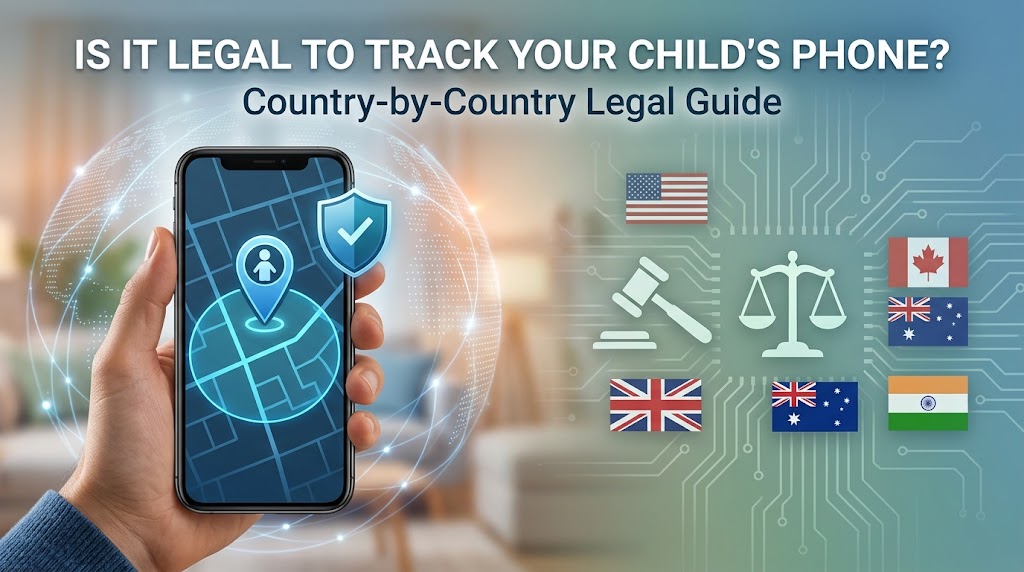
If you are wondering if it is legal to track child phone, the short answer is often, but not automatically. Parents and legal guardians generally have more authority to supervise a minor child than they would have to monitor another adult. However, privacy, interception, data protection, and surveillance laws can still apply.
The legal position also depends on what you are tracking. Checking a child’s location is different from secretly recording calls, reading private messages, capturing passwords, or monitoring another person’s communications.
This guide explains the key principles behind child tracking legal questions and looks at how the situation generally works in the United States, the United Kingdom, Canada, Australia, and India.
Important: This is general information, not legal advice. Laws can differ between states, provinces, and territories and can change over time. If you are dealing with a specific legal dispute or unusual situation, speak with a qualified lawyer in your jurisdiction.
Is It Legal to Track Child Phone?
In many situations, a parent or legal guardian can monitor a minor child’s phone, particularly when the parent owns or provides the device and the monitoring is intended to protect the child.
That does not mean every type of monitoring is automatically lawful.
There is a significant difference between:
- Checking where your child is for safety
- Setting screen-time limits
- Reviewing installed apps
- Using a parental control app feature
SpyHuman - Monitoring activity on a device you own
- Reading private communications
- Recording calls
- Secretly intercepting communications
- Tracking an adult without their knowledge
The closer monitoring gets to private communications or covert surveillance, the more carefully you should consider the law.
A good rule is to ask three questions before installing a tracking or monitoring tool:
- Whose device is it?
- Who is being monitored?
- What information are you collecting?
The answers can materially change the legal position.
Why Phone Tracking Laws Are Not the Same Everywhere
There is no single worldwide parental monitoring law that says exactly what every parent can do.
Different countries use different legal concepts, including
- Parental responsibility
- Privacy rights
- Data protection
- Consent
- Interception laws
- Electronic communications laws
- Child protection rules
- Best-interests principles
Even within one country, regional laws may differ.
For example, the United States has federal laws as well as state-specific privacy and interception rules. Canada has federal and provincial privacy frameworks. Australia has federal privacy legislation plus state and territory laws.
This is why saying “parents can legally spy on their children” is too broad.
A more accurate approach is
Parents can often use reasonable monitoring to protect a minor child, but the legality depends on the child’s age, the parent’s legal authority, the device, the type of information collected, the purpose of monitoring, and the jurisdiction.
Location Tracking vs. Message Monitoring
One of the biggest mistakes parents make is treating all monitoring as the same thing.
It isn’t.
Location tracking
Location tracking usually answers a question such as
“Where is my child right now?”
Parents may use location sharing to know whether a child arrived at school, reached home safely, or is travelling somewhere unexpected.
This is generally easier to justify as a safety measure than secretly accessing private conversations.
However, children’s location is sensitive information. Regulators increasingly emphasize transparency, data minimization, and the child’s privacy.
For example, the UK’s Information Commissioner’s Office says services that allow parents or carers to monitor a child’s activity or track their location should provide an obvious indication to the child that monitoring is taking place.
Messages and communications
Message monitoring raises a different set of concerns.
Depending on the jurisdiction and circumstances, accessing communications can involve laws concerning:
- Interception
- Wiretapping
- Electronic communications
- Privacy
- Unauthorized access
- Data protection
So a parent should not assume that because they can legally track a child’s location, they can automatically record every call or secretly read every private communication.
Country-by-Country Guide to Child Phone Tracking
The following sections provide a practical overview rather than a guarantee that a particular monitoring activity is legal in every situation.
United States
In the United States, the legal position can depend heavily on state law, the child’s age, parental authority, and what exactly is being monitored.
Parents generally have substantial authority over the care and supervision of their minor children. This is one reason parental-control tools are widely used.
But electronic communications are a more complicated area.
Federal laws can regulate the interception of electronic communications, while individual states may impose additional requirements. In particular, call recording and interception rules can vary significantly.
That means a parent should distinguish between:
- Location monitoring
- Screen-time management
- App restrictions
- Device administration
- Reading stored information
- Intercepting communications
- Recording live conversations
The first group is generally easier to justify as parental supervision. The latter activities may require more careful legal analysis.
What US parents should consider
Before using a monitoring app, check:
- Whether you are the child’s legal parent or guardian
- Whether the child is a minor
- Who owns the phone
- Whether the phone is provided by you
- What information the application collects
- Whether calls or communications are recorded
- Whether your state has stricter consent requirements
If you live in a state with specific recording or interception laws, do not rely solely on a general statement that “parents can monitor minors.”
United Kingdom
The UK takes children’s privacy seriously, particularly where online services process children’s personal information.
The Information Commissioner’s Office Children’s Code addresses issues including geolocation and parental controls.
The ICO says parental controls can create privacy risks when they monitor or track children’s online activity without adequate transparency or collect more information than necessary. It also recommends that children receive information about parental controls and monitoring.
For geolocation, the ICO emphasizes that location tracking can support safeguarding and parental controls, but services should still consider the child’s rights and provide an obvious indication when monitoring is active.
What this means for UK parents
If you are using a parental-control or location-sharing service:
- Have a clear safety reason
- Tell your child what is being monitored
- Avoid collecting unnecessary information
- Use the minimum level of monitoring needed
- Review monitoring as your child gets older
- Be especially careful with persistent location tracking
The legal and ethical question is not simply “Can a parent track a child?”
It is also: Is the monitoring proportionate to the child’s safety needs?
Canada
Canada has federal and provincial privacy frameworks, so the exact rules can depend on where you live and what organization or technology is involved.
Canadian privacy authorities have emphasized children’s privacy and the need for protective approaches to location tracking.
The Office of the Privacy Commissioner of Canada has recommended privacy-protective defaults for young people and has highlighted concerns around tracking and profiling children without sufficient justification, knowledge, or consent.
This does not mean parents can never use location sharing or parental controls.
Instead, it reinforces the importance of considering:
- The child’s age
- The reason for tracking
- The amount of information collected
- Whether tracking is necessary
- Whether the child understands the monitoring
- How the information is stored and shared
For Canadian parents, it is particularly important to distinguish reasonable parental supervision from unnecessary collection of a child’s entire digital life.
Australia
Australia has an evolving legal framework around children’s online privacy.
The Office of the Australian Information Commissioner says children’s personal information can include location and online activity. Australia’s new Children’s Online Privacy Code is designed to place stronger privacy protections around children and young people.
The OAIC has also highlighted the privacy and safety risks associated with children’s location information.
Its guidance recommends privacy-conscious approaches to children’s location and online information, including working with children when adjusting privacy settings.
The Australian framework is particularly relevant because the Children’s Online Privacy Code is being developed specifically around services likely to be accessed by children.
For parents, this means location tracking should be treated as a safety tool rather than an excuse for unlimited surveillance.
India
India’s privacy environment is also important for parents using monitoring technology.
The Digital Personal Data Protection framework has introduced a stronger focus on personal data and children’s data. Children’s personal information requires particular care, and organizations processing such information have additional obligations.
For parents, the practical distinction remains important: Using parental controls to protect your minor child is not the same as secretly monitoring another adult.
Parents should still consider:
- Their legal relationship with the child
- The child’s age
- The purpose of monitoring
- What information is collected
- Whether the service shares or stores the data
- Whether monitoring is proportionate
If the situation involves custody disputes, separated parents, or monitoring a device that is not solely under your control, professional legal advice becomes especially important.
When Is Child Tracking Usually Easier to Justify?
The strongest cases generally involve a clear safety or parental-control purpose.
Examples include:
- Checking your child’s location
A parent may want to know whether a child arrived at school, home, or another agreed destination. - Managing screen time
Parents may use parental controls to limit excessive screen use or restrict certain applications. - Blocking inappropriate content
Filtering adult or dangerous content is a common parental-control purpose. - Managing app installations
Parents may restrict applications that are inappropriate for a child’s age. - Protecting against online risks
Monitoring can sometimes help identify serious concerns such as contact from unknown adults, cyberbullying, or other safety threats.
The key is purpose and proportionality.
If the only reason for tracking is “I want to know everything my child does every minute of the day,” the privacy concerns become much stronger.
When Phone Tracking Can Become Legally Risky
There are several situations where parents should stop and check the law.
Monitoring another adult
A parent does not have unlimited authority over an adult child. Once the person being monitored is an adult, parental status alone is generally not enough to justify covert monitoring.
Tracking someone else’s phone
Using monitoring software on a phone belonging to another person without appropriate authority or consent can create serious legal problems.
Secretly recording calls
Call recording laws differ significantly between jurisdictions. Never assume that parental status automatically overrides recording requirements.
Collecting passwords
Capturing passwords or authentication information creates additional security and privacy concerns.
Monitoring a former partner through a child’s device
This is a particularly sensitive situation. If a monitoring tool installed on a child’s phone gives one parent access to another parent’s location, communications, or account information, the legal analysis can be very different.
Using tracking during custody disputes
Custody arrangements can create additional restrictions and legal complications. If a court order, parenting agreement, or custody arrangement exists, do not assume that ordinary parental monitoring rules settle the issue.
A Practical Legal-Safety Checklist for Parents
Before using a phone tracking or monitoring app, work through this checklist.
- Check 1: Confirm your authority
Are you the child’s parent or legal guardian? If the answer is unclear, obtain legal advice before monitoring. - Check 2: Check device ownership
Who purchased or controls the phone? A device provided by a parent is different from a phone belonging to another adult. - Check 3: Define your purpose
Write down the actual reason for monitoring. Good examples include safety, location during travel, screen-time management, age-appropriate parental controls, and protecting against online risks. A vague desire to “see everything” is not a strong privacy justification. - Check 4: Use the least intrusive option
If location sharing solves the problem, you may not need access to messages. If screen-time controls solve the problem, you may not need detailed activity monitoring. The less information you collect, the smaller the privacy risk. - Check 5: Talk to your child
For most families, transparency is the healthier approach. Explain what you are monitoring, why you are monitoring it, when you will check it, what you will not monitor, and when monitoring will be reduced. - Check 6: Review the arrangement as your child grows
A monitoring approach suitable for a seven-year-old may not be appropriate for a sixteen-year-old. Children gradually develop independence, and privacy expectations change with age and maturity.
Should Parents Tell Their Child About Phone Tracking?
In most ordinary family situations, yes.
Transparency helps establish expectations before a monitoring tool is installed.
You could explain it simply:
“I’m using this because I want to know you’re safe, not because I want to control every part of your life.”
Then agree on boundaries.
| Monitoring area | Possible family rule |
| Location | Used when travelling or for safety |
| Screen time | Reviewed weekly |
| Apps | New apps discussed before installation |
| Messages | Only reviewed when there is a serious safety concern |
| Social media | Age-appropriate controls |
| Emergency situations | Parents can check more closely |
The exact rules should depend on the child’s age, maturity and circumstances.
What About Tracking a Teenager?
Teenagers are where the balance becomes more complicated.
A teenager may still need protection from:
- Online predators
- Cyberbullying
- Scams
- Sextortion
- Dangerous content
- Excessive screen use
- Unknown contacts
But teenagers also have growing expectations of privacy.
A useful approach is graduated monitoring. For a younger child, parents may use stronger restrictions. For a teenager, parents can gradually shift toward location sharing, screen-time limits, app controls, safety alerts, agreed check-ins, and open conversations.
The objective should be to prepare the child for independent digital life rather than create permanent surveillance.
Is Tracking a Child’s Phone the Same as Spying?
Not necessarily.
The word “spying” suggests covert surveillance. Parental monitoring can instead be an open safety arrangement.
The difference often comes down to: Purpose + transparency + proportionality + authority.
A parent using location sharing because a child is walking home from school is very different from secretly collecting every message, password, and conversation.
This distinction is important when evaluating any monitoring app. A responsible service should clearly explain what it can do, what it cannot do, and where legal boundaries may apply.
What Should You Look for in a Child Monitoring App?
If you decide that phone monitoring is appropriate, look beyond the feature list.
Check whether the service:
- Explains lawful use clearly
- Provides privacy information
- Identifies supported devices
- Explains what data is collected
- Provides secure account access
- Allows you to control monitoring features
- Avoids promising illegal surveillance
- Explains limitations honestly
SpyHuman describes itself as a consent-based Android monitoring and parental-control service and states in its lawful use policy that it is intended for lawful use on a minor child’s device, a device owned by the user, or a company-owned device where the user has consented.
SpyHuman
That distinction matters. A monitoring company should not encourage parents to believe that installing an app makes every type of surveillance legal.
Common Mistakes Parents Make
- Mistake 1: Assuming “I’m the parent” means anything is allowed
Parental authority is important, but it is not a universal exemption from privacy and communications laws. - Mistake 2: Confusing location tracking with message interception
These can involve very different legal considerations. - Mistake 3: Ignoring the child’s age
The privacy expectations of a young child and an older teenager are not identical. - Mistake 4: Tracking another adult through the child’s phone
This can create serious legal complications, particularly in separated-family or custody situations. - Mistake 5: Keeping excessive data
If you only need location information, collecting months of detailed activity may be unnecessary. - Mistake 6: Never revisiting the arrangement
Monitoring should evolve as children become more independent.
Frequently Asked Questions
Can I legally track my minor child’s phone?
In many situations, parents or legal guardians can use parental control and tracking tools on a minor child’s device, particularly for legitimate safety and supervision purposes. However, the exact rules depend on your jurisdiction and the type of information being collected.
Is it legal to track my child’s location without them knowing?
The answer can vary. Parental authority may permit some forms of monitoring, but privacy and child-protection principles increasingly emphasize transparency. The UK’s ICO, for example, recommends that children receive clear information when parental controls or location tracking are active.
Can parents read their child’s text messages?
This is more legally sensitive than basic location tracking. The answer can depend on the child’s age, parental authority, device ownership, and local communications or interception laws. Parents should not assume that the ability to supervise a child automatically permits every form of communication interception.
Is phone tracking legal when my child turns 18?
Parental authority generally changes significantly when a child becomes an adult. Monitoring an adult’s phone without appropriate consent or legal authority can create serious privacy and surveillance issues.
Can I track my child during a custody dispute?
This is a situation where you should obtain jurisdiction-specific legal advice. Custody orders, parenting agreements, and the rights of both parents can affect what monitoring is appropriate.
What is the safest legal approach to child phone monitoring?
Use monitoring for a clear safety purpose, collect only the information you actually need, be transparent with your child where appropriate, secure the data, and check the laws that apply in your country or region.
The Bottom Line: Is It Legal to Track Your Child’s Phone?
So, is it legal to track your child’s phone?
In many circumstances, yes. Parents and legal guardians often have legitimate authority to supervise a minor child’s device, particularly when the phone is provided by the parent and monitoring is being used for safety or parental-control purposes.
But “parental monitoring” is not a blanket permission to conduct unlimited surveillance.
The safest approach is to consider four things: Authority. Purpose. Proportionality. Transparency.
Know who owns the device. Understand exactly what information you are collecting. Use the least intrusive monitoring method that solves the safety problem. And remember that children have privacy interests too.
If you want to understand how responsible monitoring works in practice, explore SpyHuman’s guidance on monitoring your child’s phone and tracking your child’s phone location on Android. You can also review SpyHuman’s About Us and Legal information before deciding whether a monitoring solution is appropriate for your family.
The goal should not be to watch every moment of a child’s life. It should be to help keep them safe while gradually teaching them how to manage their own digital world responsibly.

Leave a Reply