
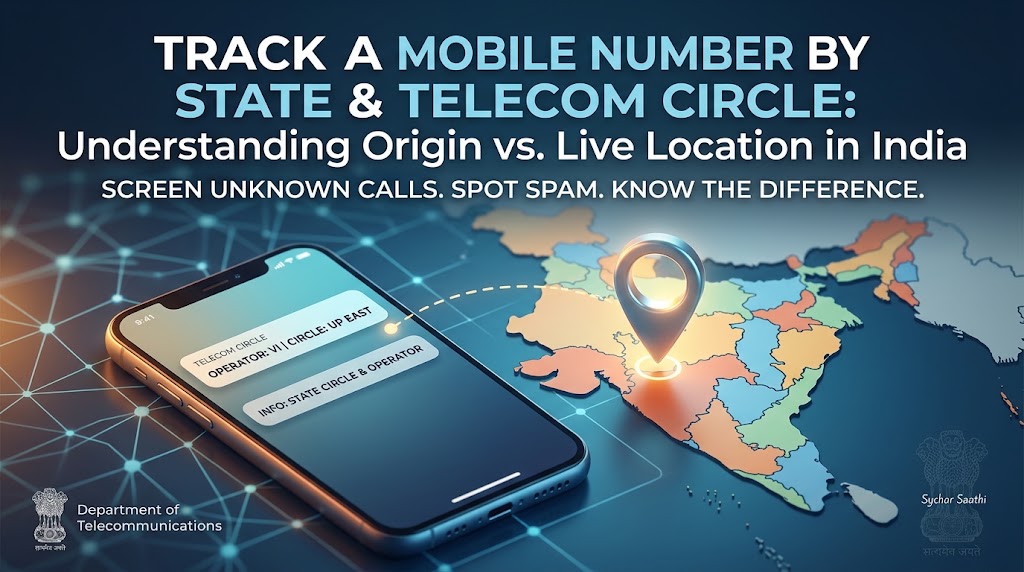
Enter an Indian mobile number on any tracer site to track mobile number by state and operator, and it might return a result like Uttar Pradesh East, Vi. Most people read that as “the phone is up right now.” It isn’t. Here is what that result actually means, how the mapping works, and why it is useful for screening a call but useless for finding where someone is.
What a telecom circle is
India splits its mobile networks into 22 licensed service areas called telecom circles. Some are whole states like Kerala or Gujarat. Some are metros like Delhi or Mumbai. A few group smaller regions together, like North East.
When an operator issues a SIM, the number is tied to the circle it was sold in. That link is built into the number’s series, which is why a lookup can name the circle and operator without knowing anything about the phone’s current position.
The circles are also grouped into categories, based mostly on revenue and population. Metro circles are the big cities. Category A covers the largest states by telecom activity. B and C cover the rest. Here is the standard breakdown.
| Category | Circles |
| Metro | Delhi, Mumbai, Kolkata |
| Category A | Maharashtra, Gujarat, Andhra Pradesh, Karnataka, Tamil Nadu |
| Category B | Kerala, Punjab, Haryana, Rajasthan, Madhya Pradesh, West Bengal, Uttar Pradesh East, Uttar Pradesh West |
| Category C | Bihar, Odisha, Assam, Northeast, Himachal Pradesh, Jammu and Kashmir |
Chennai used to be its own metro circle, but it was merged into the Tamil Nadu circle years ago, which is why you will sometimes see older tools still list it separately.
How the number series maps to a circle
Every Indian mobile number is 10 digits and starts with 6, 7, 8, or 9. If yours comes with a +91 or a leading 0, remove it and keep the 10 digits.
The opening digits sit inside blocks that the Department of Telecommunications allocates to each operator in each circle. Jio gets certain ranges in Maharashtra, and Airtel gets others in Karnataka, and so on. A lookup tool holds a copy of that allocation table, matches your number’s prefix against it, and returns the operator and circle. That is the entire mechanism. No towers, no GPS, no live data, just a prefix checked against a public list.
This is why the answer comes back instantly and costs nothing. The tool is not “tracking” anything. It is reading a lookup table, the same way a pin code tells you a delivery zone.
A worked example
Take a number like 98XXXXXXXX. The 98 series was among the first allocated when mobile phones spread in India, so a 98 number is usually an older connection. The next few digits narrow it to a specific operator and circle in the allocation table, say a Delhi metro range on a particular network.
A 70 or 61 number, by contrast, is newer, from the ranges opened up once the 9-series filled and DoT released 6, 7, and 8 for mobiles. So the leading digits give you a rough age of the connection as well as its origin. None of that tells you where the phone is today, only where and roughly when the number was born.
Why the state result can be wrong
Two things throw it off, and both matter.
Number portability: You can keep your number when you switch operators or move across the country. So a number issued in Bihar 10 years ago, ported to a new operator and carried to Bengaluru, still reads as Bihar on most tools. The circle shows where the number started its life, not where it lives now. I get into this more below, because it is the single biggest reason people misread these results.
Stale databases: Many free tracer sites refresh their allocation tables only occasionally. A newer series can show as “unknown,” land on the wrong operator, or miss a recent reallocation until the site catches up. So two different tools can give you two different operators for the same number, and the more recently updated one is usually right.
Mobile number portability, explained
Portability is the feature that breaks naive tracking, so it is worth understanding.
India launched mobile number portability in 2011 and made it fully nationwide in 2015, so you can now port a number between operators and between circles while keeping the same digits. To port, you send an SMS reading PORT followed by your number to 1900, get a unique porting code, and hand it to the new operator.
The result, years later, is a huge share of active numbers whose current operator and location have nothing to do with their original series. A “Kolkata, BSNL” result can be a Jio user sitting in Pune. So the circle is a reliable clue to a number’s birthplace and a poor clue to its owner’s operator or whereabouts today.
What this lookup is good for
Plenty, as long as you read it correctly.
- Sanity-checking an unknown call: A “Rajasthan” circle on a number claiming to be your Mumbai bank branch is a useful red flag.
- Sorting spam: Repeated calls from one far-off circle you have no ties to are easy to recognize and block.
- Rough context before you call back: paired with the caller ID and search checks in reverse phone lookup: who called me.
- A quick age estimate of a connection: from its series, which occasionally helps you judge whether a “new bank official” is calling from a suspiciously fresh number.
What it is not
It is not a live location. It will not put a moving dot on a map, and it will not reveal the caller’s address. Any site claiming to show a stranger’s exact spot from their number is selling the circle as if it were GPS and charging you for the illusion.
Real, continuous location needs a proper method: the person sharing their location with you, a Find My Device-style tool on a phone you own, or consent-based monitoring on a child’s device. That whole subject is covered in how to track a phone number location, and the consent-based route is our phone number tracker.
Bonus: STD codes for landlines
The same idea works for landlines through STD codes. A landline number carries an area code that maps to a city or district: 011 for Delhi, 022 for Mumbai, 033 for Kolkata, 044 for Chennai, 080 for Bengaluru, and 040 for Hyderabad. A quick search for “[STD code] which city” names the place.
Landlines are easier to pin to a real location than mobiles, because the code is tied to a fixed exchange that does not move and cannot be ported across the country the way a mobile can.
How to actually check a number
- Strip any +91 or leading 0, leaving the 10 digits.
- Run it through a current mobile-number tracer or your operator’s tools to read the operator and circle.
- Cross-check on a second, recently updated tool if the first looks off, since databases vary.
- Read the circle as origin, not current location, and weigh it with the number’s behavior and any caller ID.
Reading the operator result correctly
When a lookup names the operator, treat it as the network that first sold the number, not necessarily the one running it now. Thanks to portability, a number tagged BSNL in the table can be on Jio today.
If you actually need the current operator, there is a cleaner route than any tracer site. Dial the number’s associated service checks through your own carrier, or use the porting-status method: the network that answers a genuine call or SMS is the live one. For most call-screening purposes, though, the original operator is a fine enough clue, and you rarely need the current one.
Check the numbers registered in your name
Here is a use of this idea that protects you directly. The government’s Sanchar Saathi portal lets you see how many mobile connections are registered against your own identity document.
Fraudsters sometimes take out SIMs on someone else’s KYC. You can verify registered SIM connections or report fraudulent numbers directly through the Department of Telecommunications on the Sanchar Saathi Portal.
This is the flip side of number tracing. The same system that maps numbers to circles also lets you audit the numbers tied to you.
The honest summary
A by-state lookup tells you where a number was born and who first sold it. Handy for screening calls and spotting spam. Useless for finding where someone is standing right now and not a shortcut to anyone’s identity. For the full method list, the official CNAP caller ID system, and the legal limits, see the main guide: how to identify an unknown number.
Frequently asked questions
Can I find the exact location of a mobile number by its state?
No. The circle tells you where the SIM was issued, not where the phone is now. Live location is not possible from a number alone.
Why do two sites show different operators for the same number?
Because their allocation tables were updated at different times, and portability moves numbers between operators. The more recently updated tool is usually right.
What do the first digits of a mobile number mean?
They map to the operator and circle the number that was allocated to it and roughly to its age. Older 9-series numbers came first, and 6, 7, and 8 series came later.
Does portability change the circle a lookup shows?
Usually not. Most tools show the original circle from the number series, even after the number has been ported elsewhere.
How do I find the city of a landline number?
Look up its STD code. The area code maps to a fixed city or district, and a quick search names it.
Is a number registered in another circle a scam sign?
Not by itself. Plenty of people keep an old number after moving cities. But a distant circle on a call claiming to be your local bank or a nearby office is worth a second look, especially if the request involves money or an OTP.




Leave a Reply