
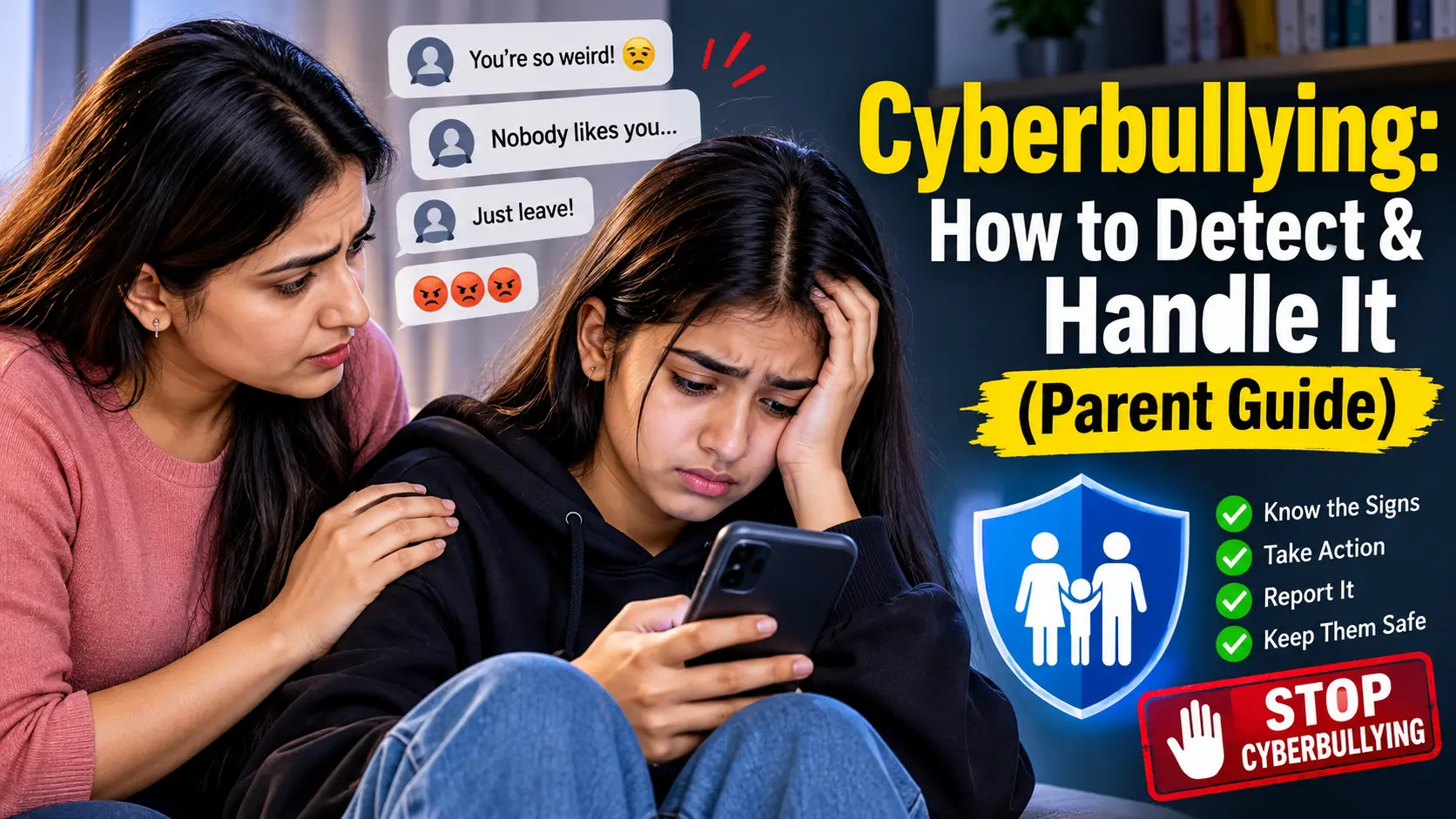
Your child comes home quiet. They check their phone under the table, flinch at a notification, and say “nothing” when you ask what’s wrong. A week later, they don’t want to go to school. You check their phone and find a group chat where three classmates have been calling them names for a month.
This is cyberbullying, and by the time most parents notice, it has been going on for weeks. This guide covers what cyberbullying actually looks like in 2026, the warning signs that show up before the child tells you, what to do when you find out, how to report it, and how to prevent it from happening again.
What cyberbullying looks like now
Cyberbullying in 2026 doesn’t look like the simple “mean messages” of ten years ago. It has evolved with the platforms.
Group-chat exclusion. A WhatsApp or Instagram group is created with “everyone except [your child].” The child knows the group exists, knows they’re left out, and can see references to it. The exclusion is the weapon.
Screenshot sharing. A private message or an embarrassing photo is screenshotted and shared in other groups, on status updates, or through AirDrop in the classroom. The content was meant to be private. Now it’s public, and the child can’t take it back.
Fake accounts. Someone creates an account impersonating the child (with their photo or a mocking version of their name) and posts embarrassing or offensive content that others attribute to the real child.
Pile-on comments. A post by the child receives a coordinated wave of negative comments, all from classmates, designed to humiliate publicly.
Rumour spreading. A false claim about the child (romantic, behavioural, personal) is spread through group chats and social media. By the time the child hears about it, dozens of people believe it.
Silent treatment online. The child posts a story or a message, and no one responds, likes, or acknowledges it, while responding enthusiastically to everyone else. This is a digital form of social isolation.
Online-to-offline crossover. What starts as online harassment becomes real-world consequences: social isolation at school, whispered conversations, or physical confrontation based on online rumours.
The warning signs parents usually miss
Most children don’t report cyberbullying. Studies consistently show that fewer than half tell a parent. The signs show up in behaviour before they show up in conversation.
Emotional changes after phone use. The child checks the phone and their mood drops. They seem upset, anxious, or angry after looking at messages or social media. This is the earliest and most reliable sign.
Withdrawal from social activities. They stop wanting to go to school, avoid friends they used to spend time with, or withdraw from group activities. Online social pain translates to real-world avoidance.
Changes in phone habits. They suddenly hide the phone, turn the screen away from you, delete messages or entire apps, or stop using a platform they were active on. A child who suddenly quits Instagram probably didn’t lose interest.
Sleep disruption. Late-night phone checking, trouble falling asleep, or not wanting the phone near them at bedtime can signal anxiety about what’s coming in.
Physical complaints. Stomach aches, headaches, or other stress-related symptoms that don’t have a medical explanation, especially on school mornings.
Declining grades. Difficulty concentrating, missed assignments, or a drop in performance that doesn’t have another explanation.
None of these alone proves cyberbullying. But a cluster of two or three, especially with phone-related emotional changes, is worth a conversation.
What to do when you find out
The first response matters enormously. Getting it right keeps the child talking. Getting it wrong teaches them never to tell you again.
Listen without reacting. The child took a risk by telling you (or letting you find out). If your first response is anger (“Why didn’t you tell me sooner?” or “What did you do to provoke this?”), the message they hear is “I shouldn’t have said anything.” Listen first. Validate that this is real and it matters.
Don’t blame the child. Even if the child made a mistake (shared something they shouldn’t have, responded to a bully, participated in the group before being targeted), the bullying is not their fault. Address the mistake later, separately. Right now, the bullying is the problem.
Don’t take the phone. This is the most common parental mistake and the most counterproductive. Confiscating the phone punishes the victim. The child loses their social connection, and the bullying continues, now without any window for the parent to see it. Keep the phone and monitor, don’t remove.
Document everything. Before anything is deleted, take screenshots of the messages, the group, the fake accounts, the comments. Include timestamps, usernames, and the full context. This evidence is essential for school reports and police complaints.
Don’t contact the bully or the bully’s parents directly. The instinct is understandable but the outcome is usually escalation. Go through official channels (school, platform, police) instead.
How to report cyberbullying
On the platform. Every major platform (WhatsApp, Instagram, Snapchat, YouTube) has a report function for bullying and harassment. Report the specific content, the account, and if applicable, the group. The platform can remove content, ban accounts, and in serious cases, provide information to law enforcement.
To the school. If the bullying involves classmates, the school has a responsibility to act. Most Indian schools now have anti-bullying policies. Provide the evidence (screenshots) and request a meeting with the relevant authority (class teacher, counsellor, principal). Keep a written record of your report.
To the police. If the bullying involves threats, explicit content, stalking, or sexual harassment, it crosses from social behaviour into criminal behaviour. In India, file a complaint at your local cyber cell or through the 1930 cybercrime helpline and cybercrime.gov.in. For content involving minors, NCPCR (National Commission for Protection of Child Rights) is an additional authority.
Depending on the nature: Section 67 of the IT Act covers publishing obscene material. Section 354D IPC covers cyberstalking. Section 509 IPC covers insulting the modesty of a woman. POCSO covers any sexual content involving minors.
Supporting the child after
The bullying stopping is not the end. The emotional impact can linger.
Check in regularly, but don’t make every conversation about the incident. The child needs normal alongside the processing.
If the child shows signs of sustained anxiety, depression, or withdrawal even after the bullying stops, consider professional support. A school counsellor is the first step. A child psychologist is the second. There is no shame in either.
Help the child rebuild socially. Encourage in-person friendships, activities, and time with people who value them. Online social pain heals faster when offline social life is strong.
If the child wants to change schools or platforms, take that seriously. Sometimes a fresh start is the healthiest option.
Prevention: making it less likely to happen
Private accounts. On Instagram, Snapchat, and every other social platform, the child’s account should be private. This prevents strangers from accessing and using their content.
Strong friendships offline. A child with a solid group of real-world friends is more resilient to online bullying, because their social worth isn’t entirely determined by what happens on a screen.
Media literacy. Teach the child that what people post online is curated, not real, and that comparing themselves to other people’s highlight reels is a game they can’t win.
The “come to me” agreement. Establish early and reinforce often: if something online makes you uncomfortable, telling a parent is the smart move, not the weak one. The child who believes this reports bullying earlier, when it’s easier to stop.
Monitoring as a safety net. Notification monitoring (see phone notification monitoring) catches patterns (repeated negative messages, late-night activity, a sudden spike from one contact) that the child might not report. It doesn’t prevent bullying, but it shortens the time between it starting and you knowing.
The bully’s parents
If your child is being bullied by a classmate, the bully’s parents need to know, but not from you directly. Go through the school. The school can involve both families in a structured process that is more likely to produce accountability than a confrontational phone call between parents.
If your child is the bully (and this is harder to face but equally important), the school’s report is a chance to address the behaviour before it escalates. Cyberbullying by a minor can have legal consequences under the IT Act and IPC, and a pattern of behaviour documented online is hard to deny.
When your child is the bystander
Most cyberbullying has an audience: classmates who see the group chat, the comments, or the forwarded screenshots. Your child may not be the target or the bully, but they are watching.
Teach them three things. First, not forwarding or sharing the bullying content, because sharing makes the audience bigger and the harm worse. Second, that speaking up (even a “that is not okay” in the group) can shift the dynamic, because bullies feed on silence. Third, that telling an adult is not snitching, it is helping. A bystander who reports is often more effective than the victim reporting, because the bystander has less emotional distress and can act more clearly.
Cyberbullying and siblings
If you have more than one child, the dynamics matter. An older sibling seeing a younger one being bullied online may want to retaliate digitally. A younger sibling may use an older sibling’s phone to send bullying messages and the older sibling gets blamed.
Set clear rules: each child’s phone is their own, each child’s online behaviour is their own responsibility, and any bullying (by the child, to the child, or witnessed by the child) gets reported to a parent, not handled between siblings.
Frequently asked questions
How common is cyberbullying in India? Studies suggest 30 to 50 percent of Indian teenagers have experienced some form of online harassment. The rate is higher among active social media users and higher for girls than for boys.
My child is being bullied on WhatsApp. Can I see the messages? If you have a monitoring app installed (like SpyHuman), the messages are logged. On a parent-managed WhatsApp account, you control contacts but can’t read messages. On a standard account, you’d need to check the phone directly or use a notification-log app.
Should I confront the bully’s parents? Not directly. Go through the school. Direct confrontation usually escalates rather than resolves.
Can cyberbullying be reported to the police in India? Yes. If it involves threats, explicit content, stalking, or sexual harassment, it’s a criminal matter. Report on 1930 or cybercrime.gov.in.
My child won’t tell me what’s happening. What do I do? Check the behavioural signs listed above. If you suspect cyberbullying, start with a gentle, non-judgmental conversation: “I’ve noticed you seem upset after checking your phone. Is something going on that I can help with?” Don’t demand to see the phone immediately.
Does blocking the bully solve the problem? It stops direct messages from that account, but determined bullies create new accounts or use others to continue. Blocking is a first step, not a complete solution. Report to the platform and the school alongside blocking.
Updated October 2026. Sources: NCPCR, 1930 cybercrime helpline, UNICEF cyberbullying research, IT Act 2000 (India), and platform-specific reporting documentation.

Leave a Reply