
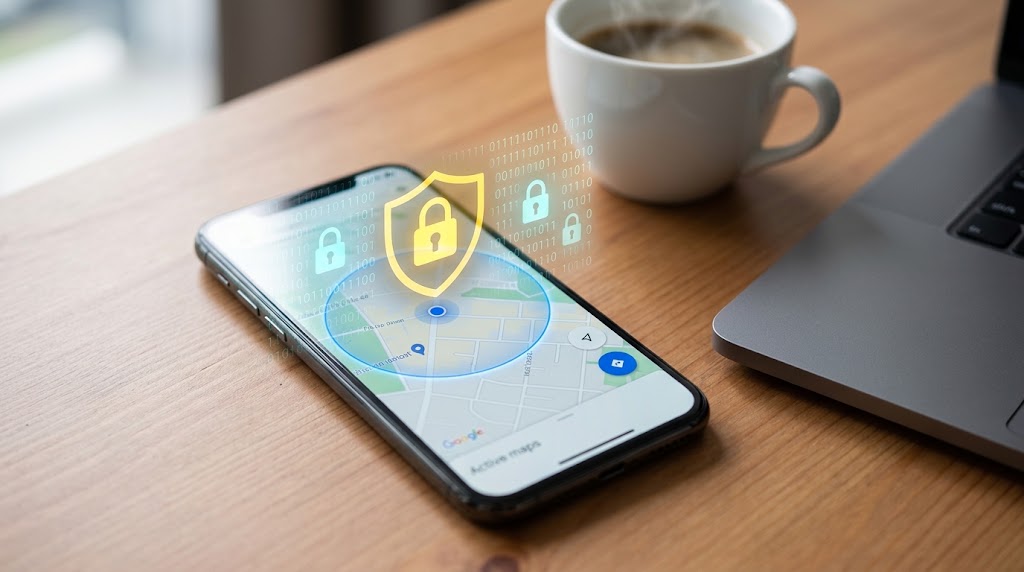
“GPS mobile number tracker” pulls over 13,000 impressions a month from people who believe there’s a way to type a phone number and track it by GPS. The idea sounds simple: every phone has GPS, so surely you can just locate it.
The reality is more useful than the fantasy but also more limited. GPS is genuinely powerful for finding your own lost phone, watching your child’s route home, or sharing your commute with family. It does not, however, let you track a stranger’s phone by their number, and understanding why saves you from wasting time on sites that pretend otherwise.
This guide covers how GPS phone tracker actually work, what affects accuracy, the difference between GPS, cell tower, and Wi-Fi positioning, what Indian conditions do to accuracy, and how to use GPS-based tools for the things they’re genuinely good at.
How GPS Phone Tracker Works
GPS stands for Global Positioning System, a network of about 30 satellites orbiting the Earth. Your phone’s GPS chip receives signals from the satellites overhead, measures how long each signal took to arrive, and uses the time differences to calculate your position in three dimensions: latitude, longitude, and altitude.
For a position fix, the chip needs signals from at least four satellites. More satellites mean a more accurate fix. In open sky, a modern smartphone locks onto 8 to 12 satellites and calculates position within 3 to 5 meters. Indoors, behind buildings, or under tree cover, fewer signals get through and accuracy drops.
The important thing: GPS works on the phone itself. The phone’s chip receives satellite signals and calculates its own position. This data stays on the phone unless the phone shares it with something, like Google Find Hub, Apple Find My, a location-sharing app, or a monitoring tool with the right permissions. GPS is not a remote antenna someone can tune into from a website.
GPS vs cell tower vs Wi-Fi: three layers
Modern phones don’t rely on GPS alone. They use three systems together, and understanding the difference explains why different tools give different accuracy.
GPS (satellite). The most accurate outdoors: 3 to 10 meters in open sky. Needs a clear view of satellites. Slow to get the first fix (can take 10 to 30 seconds from cold start). Uses noticeable battery. This is what “GPS tracking” actually refers to.
Cell-tower positioning. The phone is always connected to a cell tower, and the network knows which tower. From the tower’s location and signal strength, the phone’s position can be estimated to be within 100 to 300 meters in urban areas and up to several kilometers in rural areas with sparse towers. This is what a “carrier trace” or “cell tower triangulation” gives you. It works indoors and without GPS, but it’s neighborhood-level, not street-level.
Wi-Fi positioning. The phone scans nearby Wi-Fi networks and compares their names and signal strengths against a database of known network locations. Accuracy is typically 15 to 50 meters. This works well indoors, where GPS struggles, and it’s how your phone can locate you inside a shopping mall.
When all three work together (which they do by default on any modern smartphone with location turned on), the combined result is called “fused location.” This is what Google Maps, Find Hub, and location-sharing apps actually use. Fused location is the best accuracy your phone can achieve: GPS precision outdoors, Wi-Fi and cell assistance indoors, and smooth transitions between them.
What a GPS tracker can actually do
When we say “GPS phone tracker,” we mean any tool that reads the phone’s GPS data and reports it somewhere. Here’s what that includes.
Find your lost phone. Google Find Hub, Apple Find My, and Samsung SmartThings Find out the phone’s GPS (plus Wi-Fi and cell) to show its position on a map. This is the single most useful application of GPS tracking, and it’s free. See how to find a lost phone for the full guide.
Share your location with family. Google Maps location sharing and WhatsApp live location send your GPS position to someone you choose in real time. Both are consensual, visible to you, and stoppable at any time. See how to track a phone number location for all the methods.
Parental monitoring. Apps like Google Family Link and SpyHuman’s phone number tracker read the child’s phone GPS and report it to a parent dashboard. The parent sees continuous location history, current position, and sometimes geofence alerts (notifications when the child leaves or enters a defined area). This requires installation on the child’s device with their knowledge.
Fleet and delivery tracking. Businesses use GPS to track company vehicles, delivery riders, and field workers. The phone (or a dedicated GPS tracker device) reports position to a central dashboard. This is lawful with employee disclosure and consent, as covered in tracking with consent.
What a GPS tracker cannot do
Track a phone by its number without anything installed. GPS data exists on the phone. A phone number is a routing label for calls. No website can reach into a phone’s GPS chip using just the number. The sites that claim this are showing the SIM’s telecom circle, not GPS position. See, can you really track a phone by its number for the full myth-bust?
Track a phone that’s turned off. No GPS signal is transmitted when the phone is powered down. Newer phones (Pixel 8+, iPhone 15+) can be found when off using Bluetooth-based Find My Device/Find My networks, but that’s Bluetooth, not GPS. Older phones can only show their last known GPS position before shutdown.
Track a phone with GPS turned off. If the user disables location services, the GPS chip stops providing coordinates. Cell tower and Wi-Fi positioning may still give a rough area, but the precise GPS location is unavailable.
Provide perfect accuracy in all conditions. GPS accuracy varies with environment, and expecting a perfect dot is unrealistic. The next section explains why.
GPS accuracy in Indian conditions
India’s geography, infrastructure, and phone market create specific accuracy patterns worth knowing.
Urban dense areas (Old Delhi, Dharavi, inner Kolkata). Tall buildings bounce GPS signals off surfaces before they reach your phone, a problem called multipath interference. Accuracy drops to 20 to 50 meters, sometimes more. Wi-Fi positioning helps, but the Wi-Fi database is less complete in older neighborhoods.
Suburban and small-city areas. Accuracy is typically 5 to 15 meters, close to the global average. Cell-tower density is adequate, Wi-Fi is common, and buildings are shorter.
Rural and semi-urban areas. GPS itself works well outdoors (it’s satellite-based, so infrastructure doesn’t matter), but cell-tower positioning weakens because towers are sparse. If the phone loses GPS lock (under tree cover, inside a building), the fallback accuracy can be 500 meters to several kilometers. This matters for parental monitoring: if your child’s phone shows a location jump in a rural area, it’s probably a tower switch, not actual movement.
Budget vs. mid-range phones. A phone with a single-frequency GPS chip (many budget devices under 10,000 rupees) is typically 5 to 10 meters less accurate than a dual-frequency chip (mid-range and above). The practical difference: the budget phone might show you on the wrong side of a road, while the mid-range phone puts you on the correct building.
Network conditions. GPS itself doesn’t need mobile data (it works from satellites), but reporting that position to Find Hub or a monitoring app does need data. On a slow 2G connection in a remote area, location updates may arrive every 30 to 60 seconds instead of every few seconds, making the dot feel laggy. This isn’t a GPS problem; it’s a data-upload problem.
For a deeper dive into accuracy testing and factors, see how accurate is phone GPS tracking.
GPS tracker devices vs. phone apps
A dedicated GPS tracker (like a Jiobit, an Apple AirTag, or a Xiaomi Tag) is a separate device you attach to a bag, a vehicle, or a set of keys. It has its own GPS chip and its own battery, and it reports position through a cellular or Bluetooth connection.
The advantage over phone-based tracking: a GPS device doesn’t depend on someone’s phone being charged, turned on, or having location enabled. It tracks the object it’s attached to, not a person’s phone, so it works even when the phone is forgotten or off.
The disadvantage: it only tracks the object. Attach it to a bag, and it tells you where the bag is. It doesn’t tell you who’s carrying it or what they’re doing. And in India, dedicated GPS trackers with cellular connectivity need a SIM, which means a carrier subscription.
For lost-item tracking without a SIM, Bluetooth tags like AirTag and Xiaomi Tag use crowdsourced networks (Apple’s Find My network, Google’s Find Hub network) to relay position. They work well in cities with high phone density but poorly in remote areas with few nearby phones.
The legal angle
Using GPS to track your own device is always lawful. Using it to track your minor child’s device is lawful under parental authority in most jurisdictions, done openly. Using it to track another adult without their consent is illegal, the same principle that applies to every tracking method. GPS doesn’t create a special exception.
Placing a GPS tracker device on someone else’s vehicle without their knowledge is illegal in most jurisdictions, including India (IT Act, privacy laws) and the US (Supreme Court ruling in United States v. Jones, 2012).
The full legal picture is in: is it legal to track a phone.
Making GPS work better on your phone
A few settings that improve GPS accuracy and speed.
Turn on “Google Location Accuracy” (or “Wi-Fi and mobile network scanning” on some phones). This allows the phone to use Wi-Fi and cell data alongside GPS for a fused, more accurate fix.
Keep your phone’s software updated. GPS improvements often arrive in system updates.
Give location-critical apps “Always” or “While using” permission, not “Ask every time,” which delays the fix.
When accuracy matters most (navigating, sharing location), hold the phone with a clear view of the sky for the first 10 seconds to let the GPS chip acquire satellites.
If accuracy is consistently poor, check whether your phone case blocks GPS signals (some metal cases do) or whether battery-saver mode is limiting GPS chip access.
Frequently asked questions
Can I track any phone by GPS using just their number?
No. GPS data is on the phone, not in the number. You need account access, an installed app, or the person’s cooperation. See can you track a phone by number.
How accurate is GPS in India?
3 to 15 metres in open areas, 20 to 50+ metres in dense urban environments. Budget phones are less accurate than mid-range. Rural areas work well for GPS but struggle with data upload speed.
Does GPS tracking use a lot of battery?
Continuous GPS use (like navigation or real-time monitoring) drains battery faster. Background monitoring apps optimise by polling GPS periodically rather than constantly, which reduces drain.
Can GPS work without internet?
GPS itself works without internet (it uses satellites). But reporting the position to a dashboard, map, or monitoring app requires a data connection.
Is a GPS tracker device better than a phone app?
For objects (bags, vehicles, keys), yes, because it doesn’t depend on a phone being present. For monitoring a person’s phone, a phone-based app is more practical.
Can someone block GPS on their phone?
Yes, by turning off location services. There is no way to remotely override this. If GPS is off, no tool can get a GPS fix from that phone.

Leave a Reply